
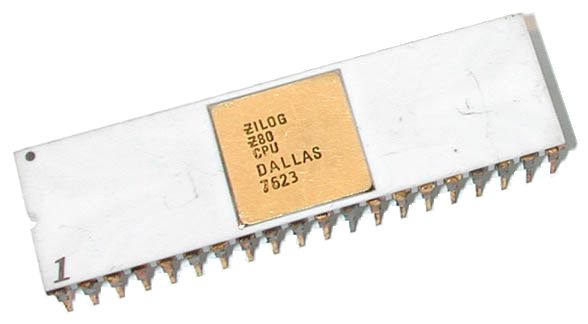
Zilog Z80 CPU Emulator
Copyright © 1999-2018 Manuel Sainz de Baranda y Goñi.
Released under the terms of the GNU General Public License v3.
This is a very accurate Z80 emulator I wrote many years ago. It has been used in several machine emulators by other people and it has been extensivelly tested. It's fast, small (33 KB when compiled as a x86-64 dynamic library), its structure is clear and the code is profusely commented.
If you are looking for an accurate Zilog Z80 CPU emulator for your project maybe you have found the correct one. I use this core in the ZX Spectrum emulator I started as hobby.
Building
To build the emulator you must install Z, a header only library that provides types and macros. This is the only dependency, the standard C library and its headers are not used and the emulator doesn't need to be dynamically linked against any library.
A premake4 file and a Xcode project and are included to build the emulator. They include the following targets:
| Target | Description |
|---|---|
| dynamic | Shared library. |
| dynamic module | Shared library with a module ABI to be used in modular multi-machine emulators. |
| static | Static library. |
| static module | Static library with a descriptive ABI to be used in monolithic multi-machine emulators. |
Prefefined macros used in Z80.h
| Name | Description |
|---|---|
CPU_Z80_DEPENDENCIES_H |
If defined, it will be used as the only header to include. If you don't want to use Z, you can provide your own header with the types and macros used by the emulator. |
CPU_Z80_OMIT_ABI_PROTOTYPE |
Avoids including <Z/ABIs/generic/emulation.h> and declaring the prototype of the global variable abi_emulation_cpu_z80. If your code does not use ABI you can declare this to make the emulator less dependant on Z. |
CPU_Z80_STATIC |
You need to define this if you are using the emulator as a static library or if you have added its sources to your project. |
Predefined macros used in Z80.c
| Name | Description |
|---|---|
CPU_Z80_BUILD_ABI |
Builds the ABI of type ZCPUEmulatorABI declared in the header with the identifier abi_emulation_cpu_z80. |
CPU_Z80_BUILD_MODULE_ABI |
Builds a generic module ABI of type ZModuleABI. This constant enables CPU_Z80_BUILD_ABI automatically so abi_emulation_cpu_z80 will be build too. This option is intended to be used when building a true module loadable at runtime with dlopen(), LoadLibrary() or similar. The module ABI can be accessed retrieving the weak symbol __module_abi__. |
CPU_Z80_HIDE_API |
Makes the API functions private. |
CPU_Z80_HIDE_ABI |
Makes abi_emulation_cpu_z80 private. |
CPU_Z80_USE_LOCAL_HEADER |
Use this if you have imported Z80.h and Z80.c to your project. Z80.c will include "Z80.h" instead of <emulation/CPU/Z80.h>. |
API
The Z80 emulator instance object
This structure contains the state of the emulated CPU and callback pointers necessary to interconnect the emulator with external logic. There is no constructor function, so, before using an object of this type, some of its members must have been initialized, in particular the following: context, read, write, in, out, int_data and halt.
Descriptions of each member follow:
zusize cycles;
Description
Number of cycles executed in the current call to z80_run.
Details
z80run sets this variable to 0 before starting to execute instructions and its value persists after returning. The callbacks can use this variable to know during what cycle they are being called.
void *context;
Description
The value used as the first argument when calling a callback.
Details
This variable should be initialized before using the emulator and can be used to reference the context or instance of the machine being emulated.
ZZ80State state;
Description
CPU registers and internal bits.
Details
It contains the values of the registers, as well as the interruption flip-flops, variables related to interruptions and other necessary flags. This is what a debugger should use as data source.
Z16Bit xy;
Description
Temporay IX/IY register for instructions with DDh/FDh prefix.
Details
Since instructions with prefix DD and FD behave similarly, differing only in the use of register IX or IY, for reasons of size optimization, a single register is used that acts as both. During opcode analysis, the IX or IY register is copied to this variable and, once the instruction emulation is complete, its contents are copied back to the appropriate register.
zuint8 r7;
Description
Backup of the 7th bit of the R register.
Details
The value of the R register is incremented as instructions are executed, but its most significant bit remains unchanged. For optimization reasons, this bit is saved at the beginning of the execution of z80_run and restored before returning. If an instruction directly affects the R register, this variable is also updated accordingly.
Z32Bit data;
Description
Temporary storage for opcode fetching.
Details
This is an internal private variable.
zuint8 (* read)(void *context, zuint16 address);
Description
Callback: Called when the CPU needs to read 8 bits from memory.
Parameters
context → The value of the member context.
address → The memory address to read from.
Returns
The 8 bits read from memory.
void (* write)(void *context, zuint16 address, zuint8 value);
Description
Callback: Called when the CPU needs to write 8 bits to memory.
Parameters
context → The value of the member context.
address → The memory address to write to.
value → The value to write.
zuint8 (* in)(void *context, zuint16 port);
Description
Callback: Called when the CPU needs to read 8 bits from an I/O port.
Parameters
context → The value of the member context.
port → The number of the I/O port to read from.
Returns
The 8 bits read from the I/O port.
void (* out)(void *context, zuint16 port, zuint8 value);
Description
Callback: Called when the CPU needs to write 8 bits to an I/O port.
Parameters
context → The value of the member context.
port → The number of the I/O port to write to.
value → The value to write.
zuint32 (* int_data)(void *context);
Description
Callback: Called when the CPU starts executing a maskable interrupt and the interruption mode is 0. This callback must return the instruction that the CPU would read from the data bus in this case.
Parameters
context → The value of the member context.
Returns
A 32-bit value containing the bytes of an instruction. The instruction must begin at the most significant byte (big endian).
void (* halt)(void *context, zboolean state);
Description
Callback: Called when the CPU enters or exits the halt state.
Note
This callback is optional and must be set to NULL if not used.
Parameters
context → The value of the member context.
state → TRUE if halted; FALSE otherwise.
Functions
void z80_power(Z80 *object, zboolean state);
Description
Changes the CPU power status.
Parameters
object → A pointer to a Z80 emulator instance object.
state → TRUE = power ON; FALSE = power OFF.
void z80_reset(Z80 *object);
Description
Resets the CPU by reinitializing its variables and sets its registers to the state they would be in a real Z80 CPU after a pulse in the RESET line.
Parameters
object → A pointer to a Z80 emulator instance object.
zusize z80_run(Z80 *object, zusize cycles);
Description
Runs the CPU for a given number of cycles.
Note
Given the fact that one Z80 instruction needs between 4 and 23 cycles to be executed, it's not always possible to run the CPU the exact number of cycles specfified.
Parameters
object → A pointer to a Z80 emulator instance object.
cycles → The number of cycles to be executed.
Returns
The number of cycles executed.
void z80_nmi(Z80 *object);
Description
Performs a non-maskable interrupt.
Details
This is equivalent to a pulse in the NMI line of a real Z80 CPU.
Parameters
object → A pointer to a Z80 emulator instance object.
void z80_int(Z80 *object, zboolean state);
Description
Changes the state of the maskable interrupt.
Details
This is equivalent to a change in the INT line of a real Z80 CPU.
Parameters
object → A pointer to a Z80 emulator instance object.
state → TRUE = line high; FALSE = line low.
Use in Non-Free / Proprietary Software
This library is released under the terms of the GNU General Public License v3, but I can license it for non-free projects if you contact me.