The tran
ZPUter
FusionX is a spinoff concept from the tranZPUter series. It shares the same purpose, to replace the physical Z80 in a Sharp or similar system and provide it with features such as faster CPU, more memory, virtual devices,
rapid application loading from SD card and by using a daughter board, better graphics and sound.
The
FusionX board can also be used to power alternative CPU's on the host for testing, development and to provide a completely different software platform and applications. It can use the underlying hosts keyboard, monitor, I/O and additionally better graphics and sound provided by the
FusionX.
It shares similarities with the tran
ZPUter
Fusion but instead of realising it in hardware via an FPGA it realises
it in software as an application. This is made possible by a SOM (System On a Module), not much bigger than an FPGA device yet provides an abundance of features, ie. dual-core 1.2GHz Cortex-A7 ARM CPU, 128MB RAM, 256MB FlashRAM, Wifi, HD Video, SD Card, USB port and runs the Linux operating system.
Using the same base design as the tran
ZPUter
Fusion it incorporates a CPLD to interface the Z80 host to the SOM and provide cycle accurate Z80 timing. The SOM interfaces to the CPLD via a 72MHz SPI channel and an 8bit bus to query signal status and initiate Z80 transactions.
In Z80 configuration, a Linux Kernel driver instantiates a Z80 emulation which realises a Z80 CPU in software which in turn can command and control the host system. The kernel driver along with a controlling application
can provide a wealth of features to the host through this mechanism. The SOM is also connected to an SD Drive and USB 2.0 port so there is no limit to features which can be proivded.
Like the tran
ZPUter
Fusion, the tran
ZPUter
FusionX can provide enhanced video and sound to the host. The SOM incorporates dual DAC audio and a 2D GPU with configurable resolutions switched onto the hosts video and audio outputs under software control.
The
FusionX board is ideal for any developer wanting to physically program and interact with retro hardware using a Linux platform with Wifi and USB/Serial port connectivity.
To most retro users, in the early stages of
FusionX development, the board wont have much use. As the project matures, a board can be obtained and installed into the Z80 socket of their Sharp or simlar Z80 based system (providing there is sufficient room to accommodate this board) and utilise the upgraded featues, such as:
- Original host specifications
- the machine behaves just as though it had a physical Z80 within. There might be slight differences in the Z80 functionality as it is implemented in software but the Z80 hardware timing is accurate.
- Accelerator
- the Z80 can run at much higher speeds due to the abundance of memory and 1.2GHz dual-core processor, which would typically see performance upto that of a 500MHz Z80.
- Emulation
- emulation of all the Sharp MZ series machines, experiencing it through the host system keyboard, monitor and I/O.
- Graphics
- all original Sharp MZ graphics modes, regardless of host, including additional resolutions upto HD are available through GPU configuration and these can be selected and programmed on the host in languages such as Basic.
- Sound
- the host will have access to the stereo DAC converters, which can playback 48KHz CD quality sound or emulate the SN76489 or basic bit/timer sound of the Sharp series. Sound recording is also possible via the Mic input.
- Processors
- there are many software CPU implementations which can be ported to run on this platform, for example the ARM platform CPU emulations of the BBC PiCoPro can readily be ported. This in turn allows the potential for other machines, using the SOM advanced graphics and sound as necessary, allow emulations of machines such as the BBC to run on this Sharp host.
- Linux
- using the host keyboard, speaker, monitor etc, a full blooded version of Linux, including Wifi, can be utilised at the host console.
Version 1.0 is the first official release of the tran
ZPUter
FusionX design.
The
FusionX board builds on a tried and tested Z80 host interface using the Altera 7000A MAX CPLD device. The CPLD not only interfaces the 5V Z80 host signals to the 3.3V signals on more recent devices, it also embeds the logic to perform accurate Z80 timing using a 50MHz clock to
sample the Z80 host clock and activate signals according to the published Z80 state diagrams.
In addition the
FusionX includes a SigmaStar System-On-a-Module, this is a small 29mmx29mm stamp device which incorporates a dual-core Cortex-A7 CPU, 128MByte DRAM, 256MBytes FlashNAND and a Wifi transceiver. The SigmaStar SOM is capable of outputting 2D Graphics in an RGB 888 format
with selectable resolution upto HD format. It is also capable of stereo audio DAC output at 48KHz. Click to view the full SigmaStar
product brief.
Using the experience gathered on the tranZPUter SW-700, a 30bit Video DAC is chosen to render the SigmaStar SOM video rather than a 2R-R ladder and additionally an 8bit DAC is included for rendering monochrome monitor contrast levels to cater for colour shading on monochrome CRT
monitors as found in the MZ-80A/MZ-2000.
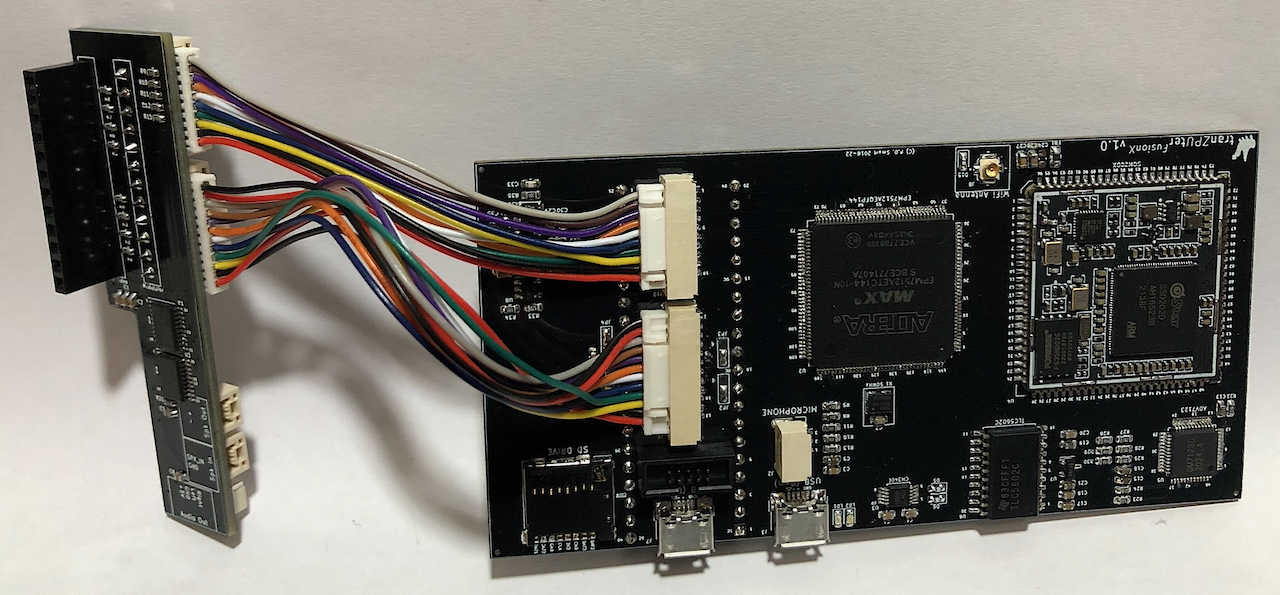
The hardware design centers on a main circuit board which holds all the primary circuitry and a number of daughter boards, each daughter board dedicated to one host (ie. MZ-700, MZ-80A, MZ-2000). The daughter board intercepts the host video/audio subsystem and supports switching
of the host video/audio and the mainboard video/audio to the monitor/speaker of the host. The mainboard can be used without daughter boards, the latter are only used when the SOM Video/Audio is required.
This section outlines the mainboard schematics and circuit board design of the tran
ZPUter
FusionX.
The SOM outputs TTL RGB with 8bits per colour. This is interfaced to a 30bit VideoDAC with the lowest 2 bits, per colour, controlled by the CPLD.
In addition, in order to drive the internal monochrome monitors of the Sharp MZ-80A/MZ-80B/MZ-2000 an 8bit VideoDAC is added which outputs a video signal in the range 4V-5V using a 332 RGB colour input, the colour input being the MSB of the SOM 888 TTL output. I term this the Contrast
DAC, as it is sending the video signal with colour information as a voltage controlled contrast signal which presents itself on the monitor as differing contrast levels, thus simulating colour as grey levels.
In order to get true black, the CPLD creates a blanking signal, MONO.BLANK, which is paired with a MUX 0V clamp on the daughter board which drives the monochrome monitor, this sees the RGB332 as 0V when 00000000 is present, then varying between 4.01V-5V when non-zero.
The PCB was designed with minimum size as a primary requirement for the various machines in which it would be installed. It also had to be compatible with the tran
ZPUter
Fusion for interchangeability.
A major concern was heat dissipation as the PCB, when installed within an MZ-700 is very close to existing motherboard components which give off a lot of heat with no air circulation in a sealed compact housing. This meant active components couldnt be sited on the PCB underside
as heat generation would lead to instability and failure, which in turn led to an increase in the final PCB size.
The smallest components which could be manually assembled where used, ie. 0402/0603 passive devices and 0.5mm IC pitch spacing to reduce overall size and a 4 layer stackup selected to fit all required components.
Click
here to view an interactive PCB component placement diagram and Bill of Materials.
The tranZPUter series was initially developed in the Sharp MZ-80A and was primarily a Z80 replacement. As the concept evolved and the tranZPUter SW-700 was developed for the MZ-700 it became more of an integral component of the machine, offering original and upgraded Video and Audio capabilites by intercepting and routing existing signals.
After significant developments on the tranZPUter SW-700 it became desirable to port it back to the MZ-80A and MZ-2000 but these machines had different CPU orientation and signal requirements, ie. driving an internal and external monitor. This requirement led to the concept of daughter boards, where a specific board would be designed and developed for
the target host and would plug into the tranZPUter SW-700 card. Ideally I wanted to port the SW-700 to an MZ-800/MZ-1500 and X1 but the size of the card and orientation of the Z80 was a limitation.
During the design of the tran
ZPUter
FusionX one of the main requirements was to make the board small, the Z80 orientation changeable and also compatible with the tran
ZPUter
Fusion so that it could fit many machines and be interchangeable. As the SW-700 also interfaced to the Video and Audio of the machines
and each was quite different, it became apparent that the tran
ZPUter
FusionX needed to include a concept to allow different video/audio interfaces according to the targetted host. This concept was realised via daughter boards. Two connectors would link the tran
ZPUter
FusionX to a daughter board which would be
specifically designed for the intended host.
The daughter boards would be responsible for switching and mixing video/audio signals and to drive internal monitors and provide the correct input and output connectors for ease of installation.
Currently three daughter boards have been developed, for the MZ-700, MZ-80A and MZ-2000 and more will follow as the design progresses.
The purpose of the MZ-700 daughter board is to interface the video/audio circuits of the
FusionX board with those of the MZ-700. It is designed to be inserted into the mainboard modulator output and the modulator connector in turn connected to the daughter board. This allows the MZ-700 to be used with a standard monitor and the video output
is switched between the MZ-700 and
FusionX under control of the
FusionX.
The original sound circuity of the MZ-700 drives a speaker directly and in order to inject
FusionX audio into the MZ-700 speaker, the mainboard speaker output is routed to the daughter board, level converted and switched under control of the
FusionX. The
FusionX offers stereo sound so this is selectively switched/mixed with the
original MZ-700 sound and fed to a Class D amplifier which then drives the internal speaker. Line level stereo output is achieved via an additional 4pin connector and used as required.
This setup allows for Linux or emulated machines, whilst running as an application on the
FusionX, to output their sound to the internal speaker.
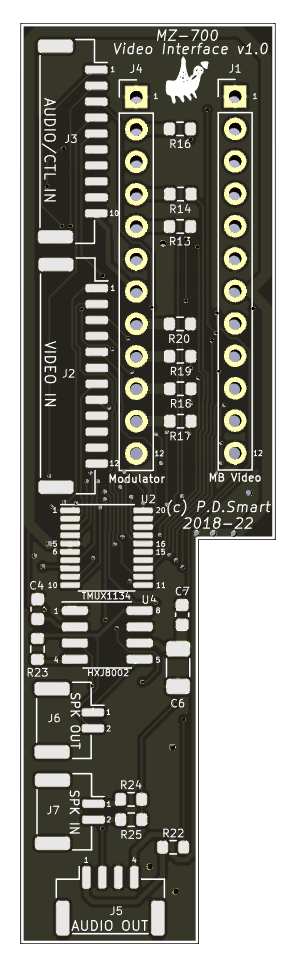
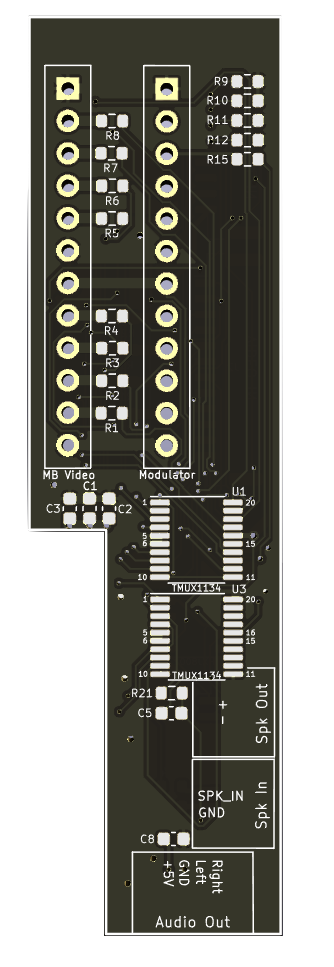
The MZ-700 daughter board consists of three 4way SPDT analogue switches to route video and audio signals under FusionX control and a Class D power amplifier.
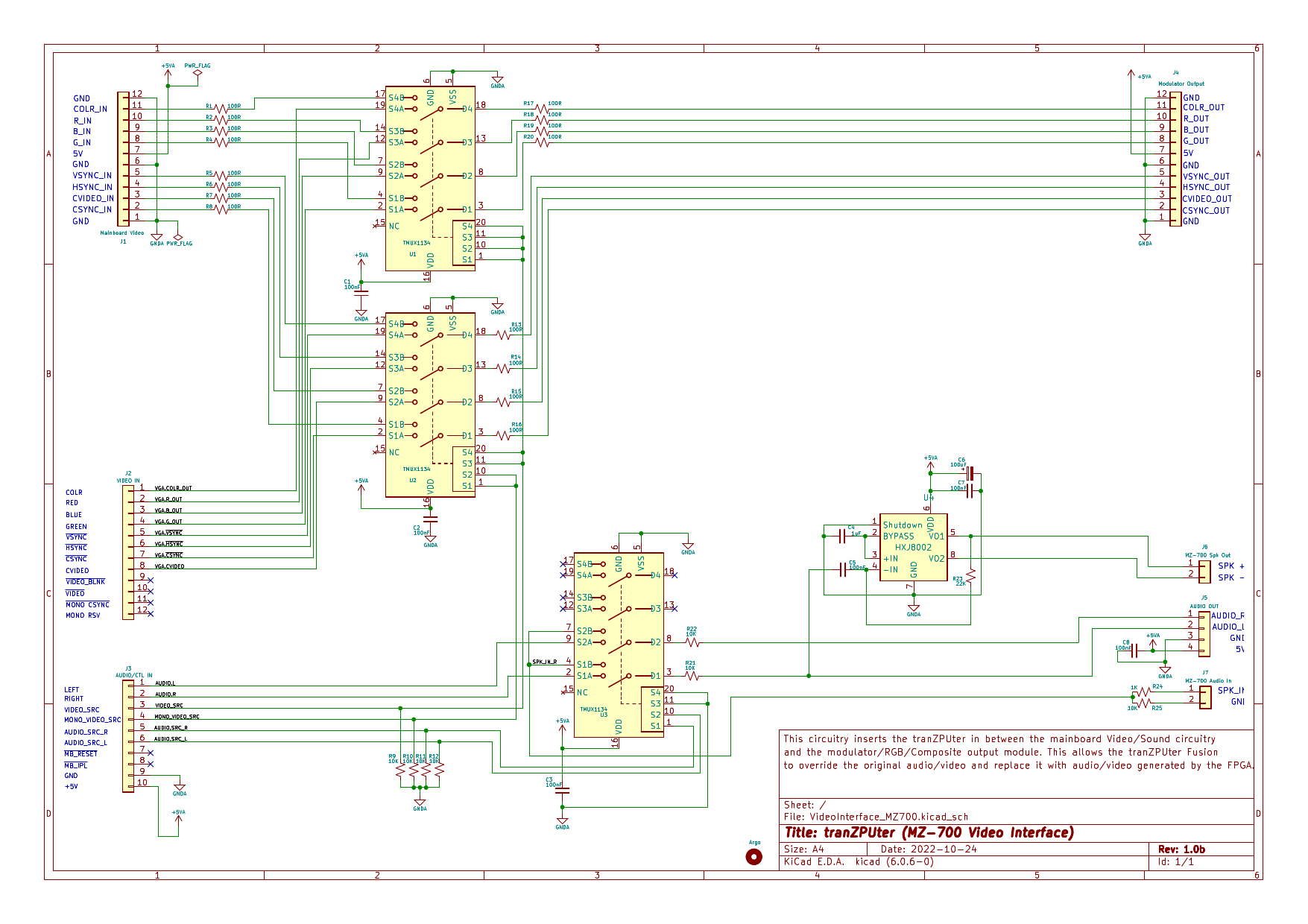
MZ-700 Video Interface PCB
The MZ-700 daughter board PCB is small and compact due to the space restrictions. It has to fit onto the existing modulator connector and within the available free space.
--------------------------------------------------------------------------------------------------------
###### MZ-2000 Daughter Board
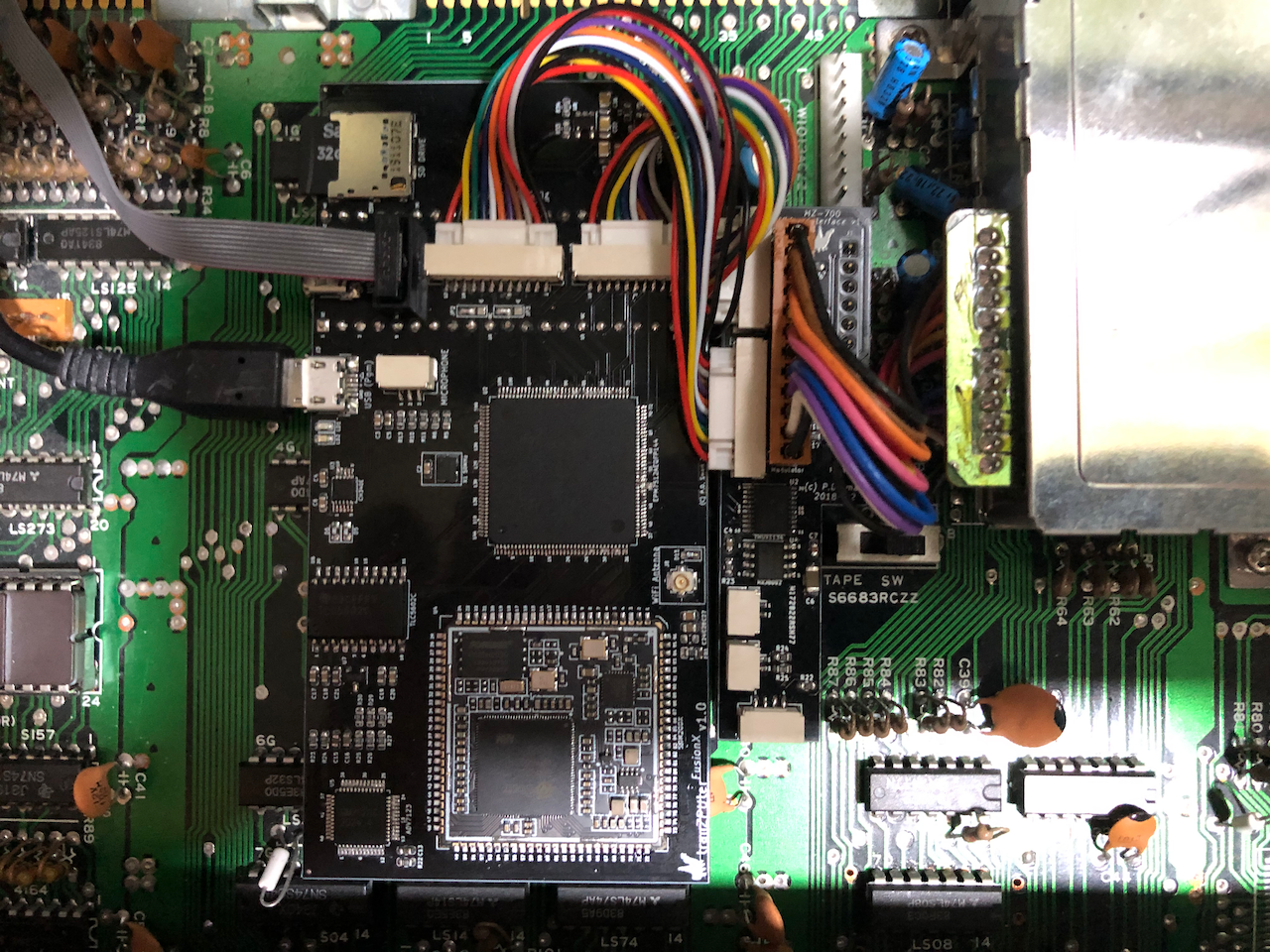
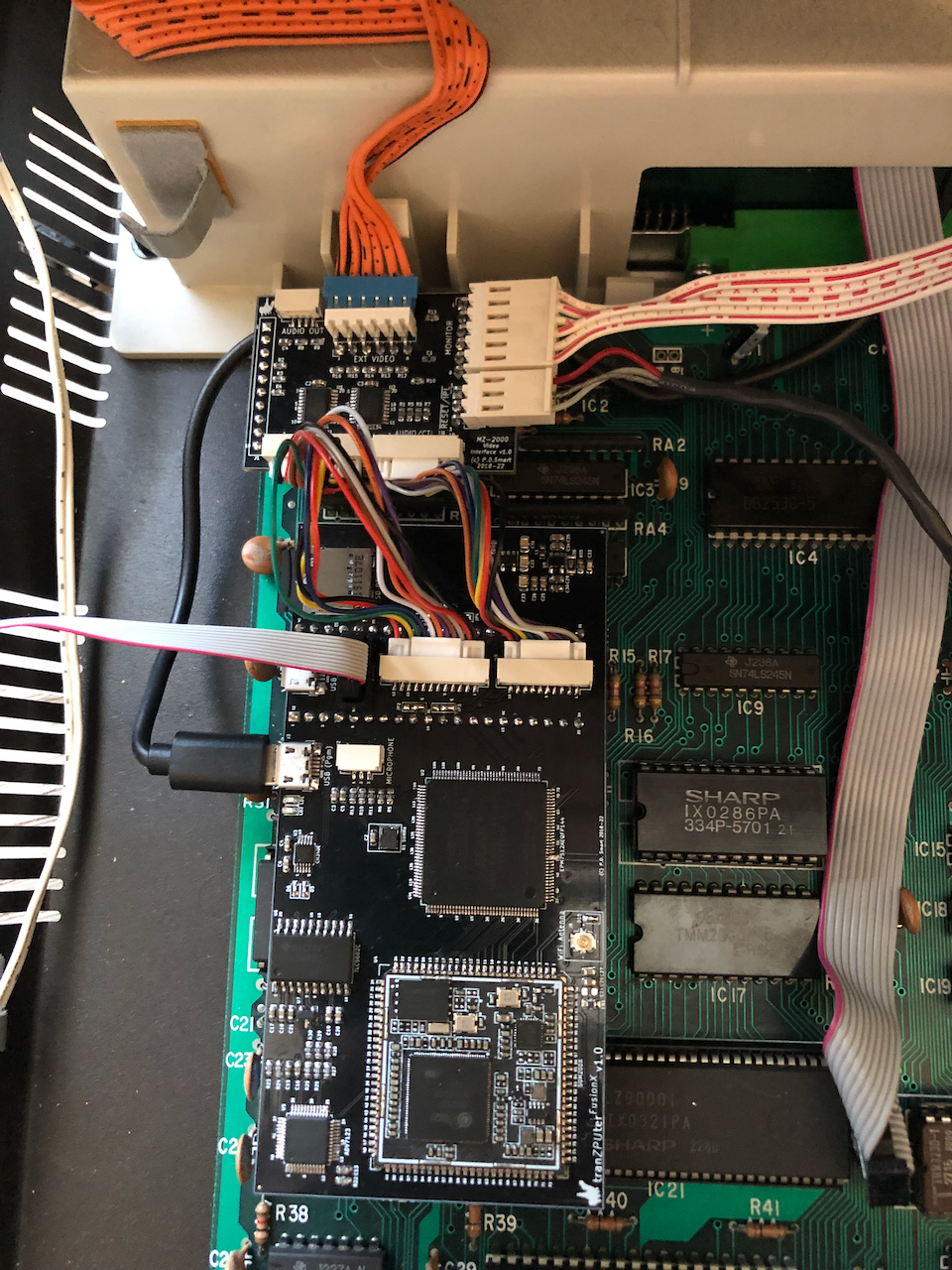
The purpose of the MZ-2000 daughter board is to interface the video/audio/reset circuits of the
FusionX board with those of the MZ-2000. The MZ-2000 has an internal monochrome CRT, external RGB video and internal Audio with an amplifier on the monochrome CRT control board.
The daughter board is designed to be inserted simultaneously into the mainboard monitor and IPL connectors. It presents all the required connectors to connect the IPL/RESET switches, internal monitor and external monitor on the same board.
The IPL and RESET inputs are intercepted on the daughter board and sent to the
FusionX as the MZ-2000 operates in different modes dependent on which RESET key is pressed during a Z80 Reset.
The video signals from the mainboard are switched with the
FusionX video monochrome signals and sent to the internal CRT monitor. This allows for original video output on the CRT monitor or advanced
FusionX text and graphics, resolution subject to the timing constraints of the monitor.
The
FusionX RGB output is routed to the MZ-2000 external RGB video socket allowing for upto full HD external colour video display.
The sound circuity of the MZ-2000 is sent to an audio amplifier on the CRT monitor. This signal is intercepted and switched with the
FusionX audio which then drives the CRT monitor amplifier. Line level stereo output is achieved via an additional 4pin connector and used as required.
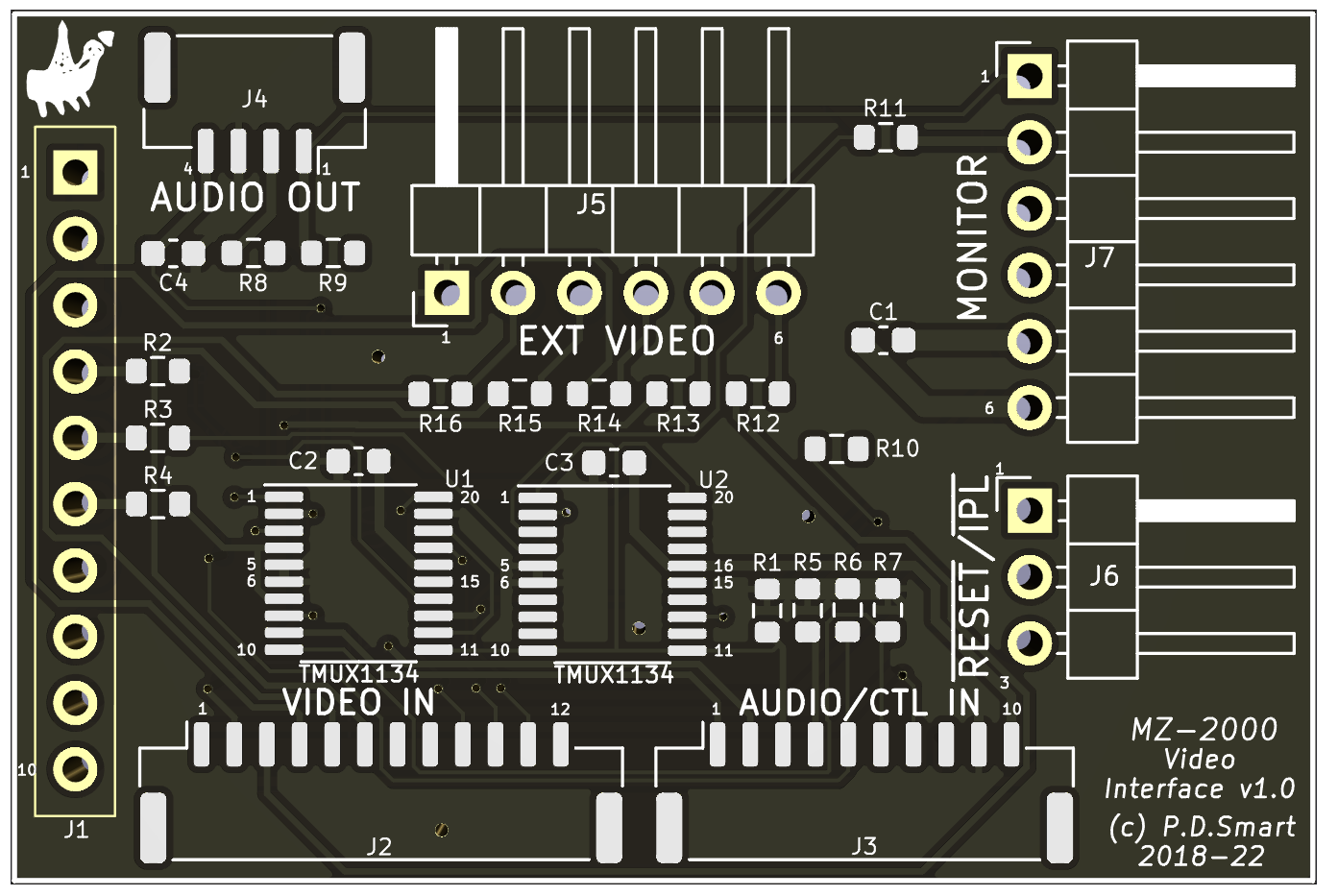
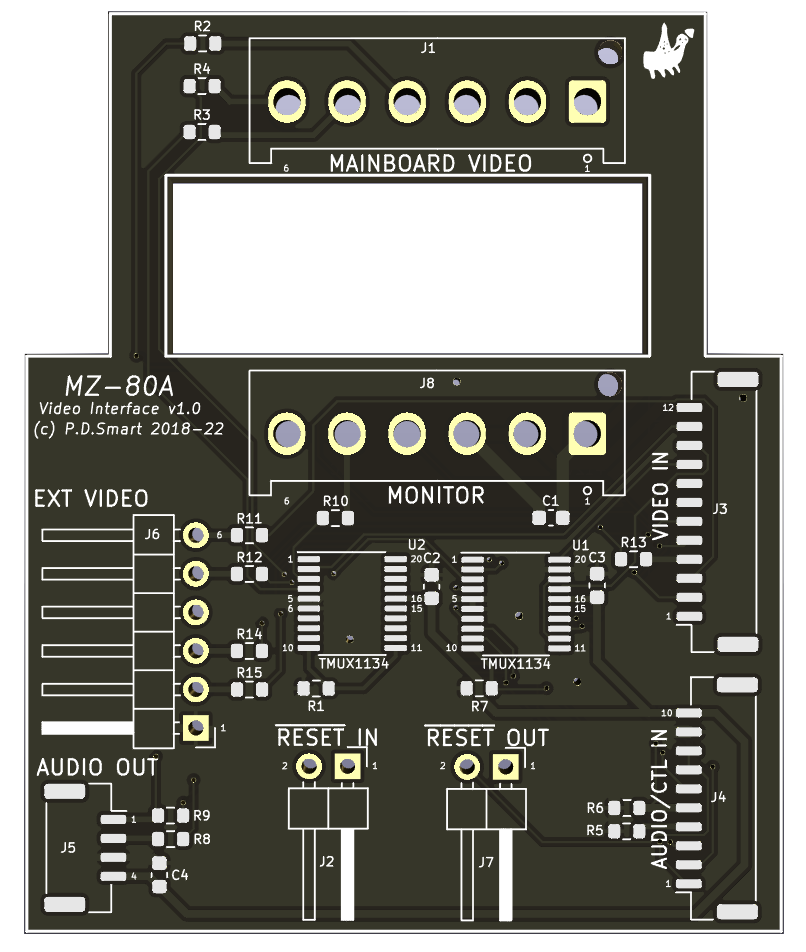
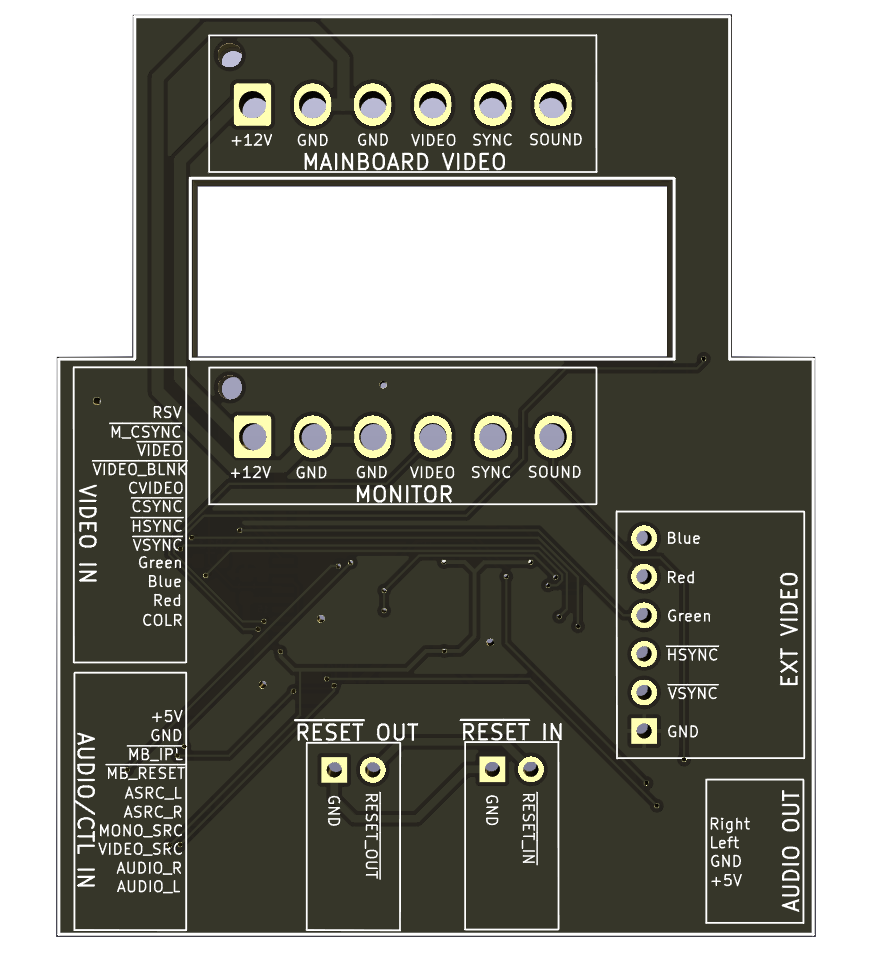
The MZ-2000 daughter board consists of two 4way SPDT analogue switches to route video and audio signals under FusionX control. One SPDT switch is used for creating pure black in the modified video signal generated on the FusionX board.
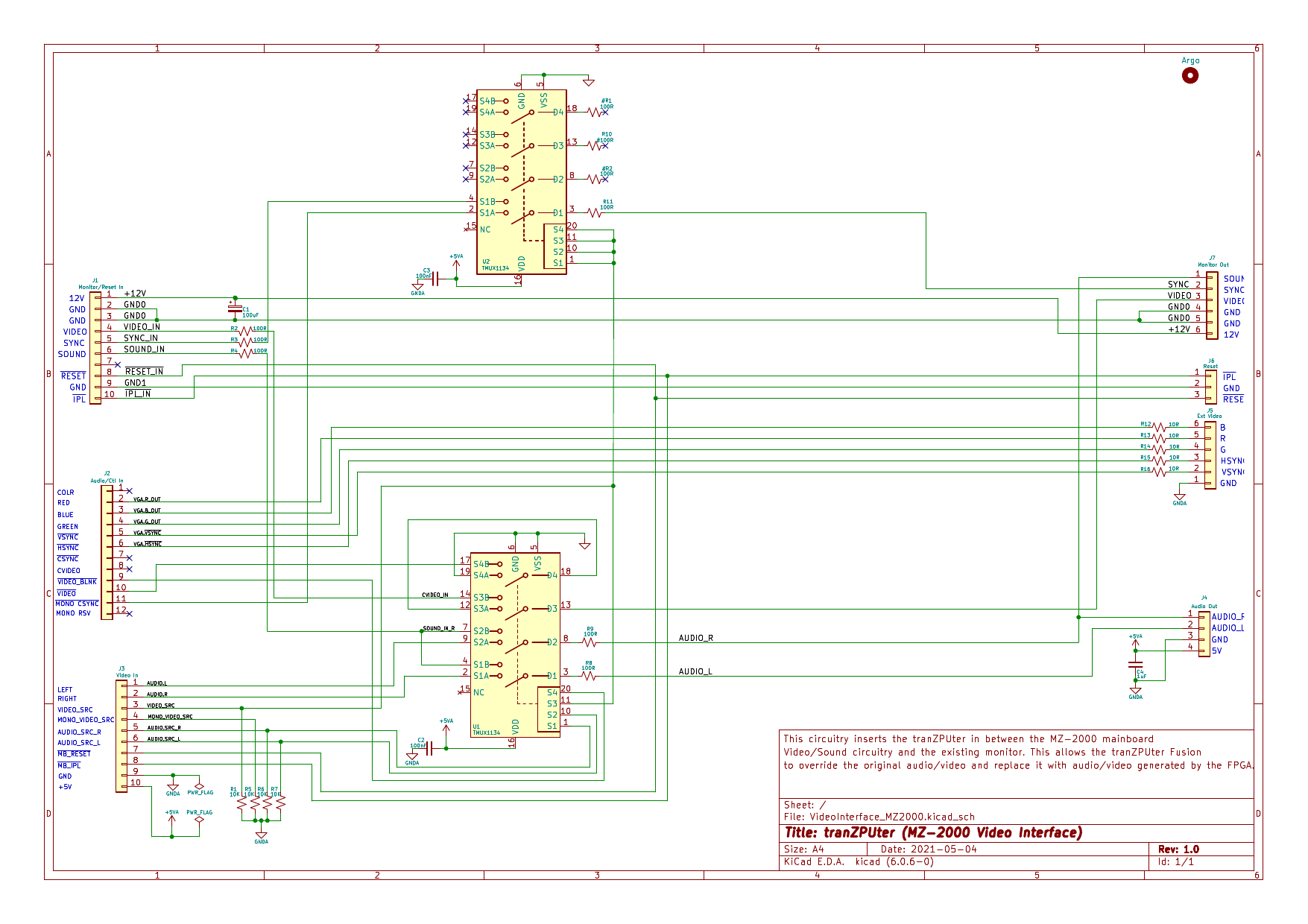
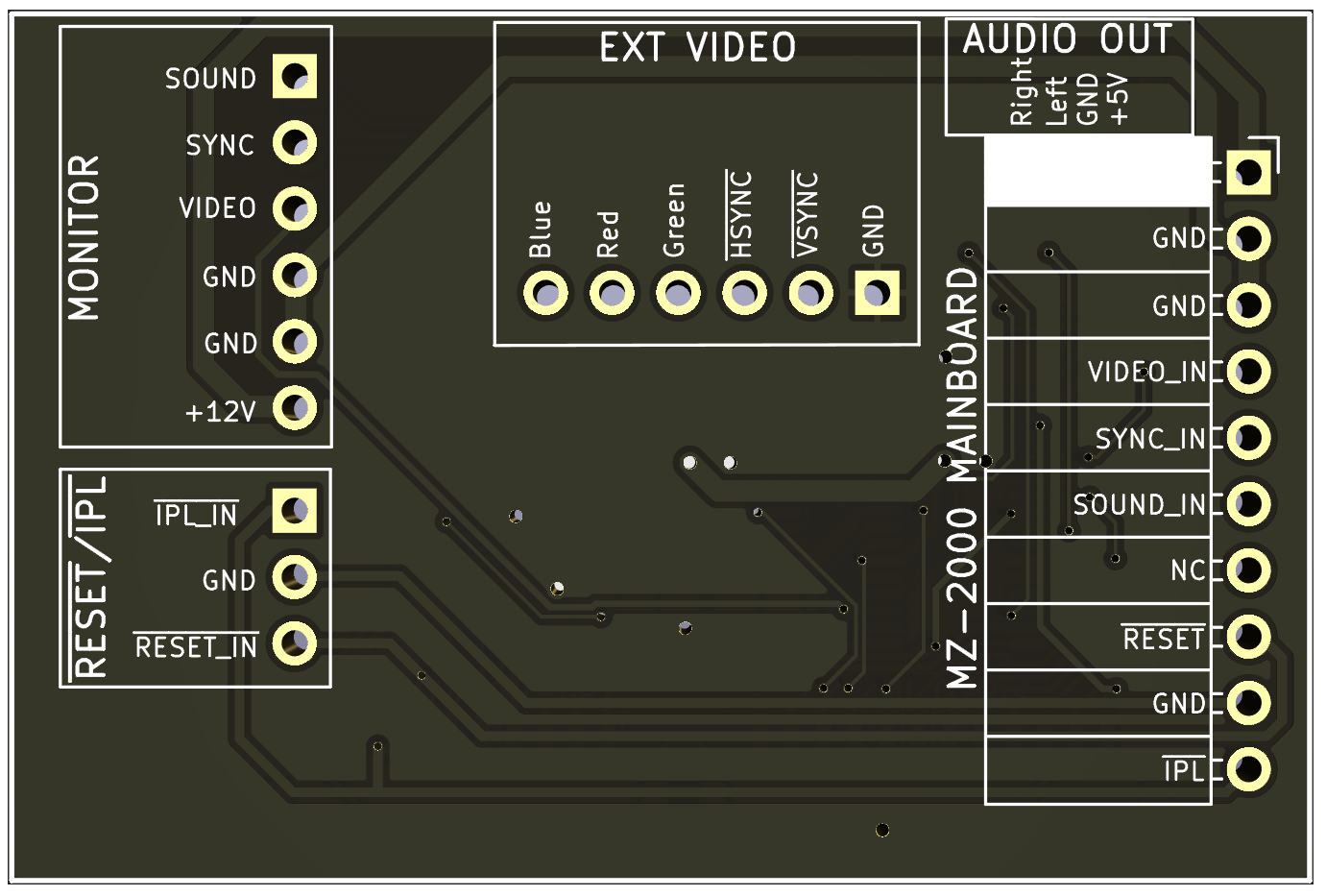
MZ-2000 Video Interface PCB
The MZ-2000 daughter board PCB is small and compact due to the space restrictions and the number of connectors it must carry. It plugs into the mainboard monitor/IPL male connectors and then presents new CRT monitor, external Video and IPL/RESET switch connectors for all the exising internal cabling.
--------------------------------------------------------------------------------------------------------
###### MZ-80A Daughter Board
The purpose of the MZ-80A daughter board is to interface the video/audio/reset circuits of the
FusionX board with those of the MZ-80A. The MZ-80A has an internal monochrome CRT, cutouts for and external RGB video socket and internal Audio with an amplifier on the monochrome CRT control board.
The daughter board is designed to plug into the vertical mainboard CRT video connector with a gap so that the data cassette connector can be simultaneously connected. The gap is necessary as the CRT video connector sits close to the rear sidewall so the daughter board must extend forwards towards the keyboard.
It presents all the required connectors to connect the RESET switch (both in and out), internal monitor and external monitor on the same board.
The RESET input is intercepted on the daughter board and sent to the
FusionX. Technically it isnt needed as the
FusionX samples the Z80 Reset which is based on this input, but it can be useful, for example, detecting requests to reboot the SOM (double press) rather than the MZ-80A circuitry.
The video signals from the mainboard are switched with the
FusionX video monochrome signals and sent to the internal CRT monitor. This allows for original video output on the CRT monitor or advanced
FusionX text and graphics, resolution subject to the timing constraints of the monitor.
The
FusionX RGB output is routed to the MZ-80A external RGB video socket (if installed) allowing for upto full HD external colour video display.
The sound circuity of the MZ-80A is sent to an audio amplifier on the CRT monitor. This signal is intercepted and switched with the
FusionX audio which then drives the CRT monitor amplifier. Line level stereo output is achieved via an additional 4pin connector and used as required.
The MZ-80A daughter board consists of two 4way SPDT analogue switches to route video and audio signals under FusionX control. One SPDT switch is used for creating pure black in the modified video signal generated on the FusionX board.
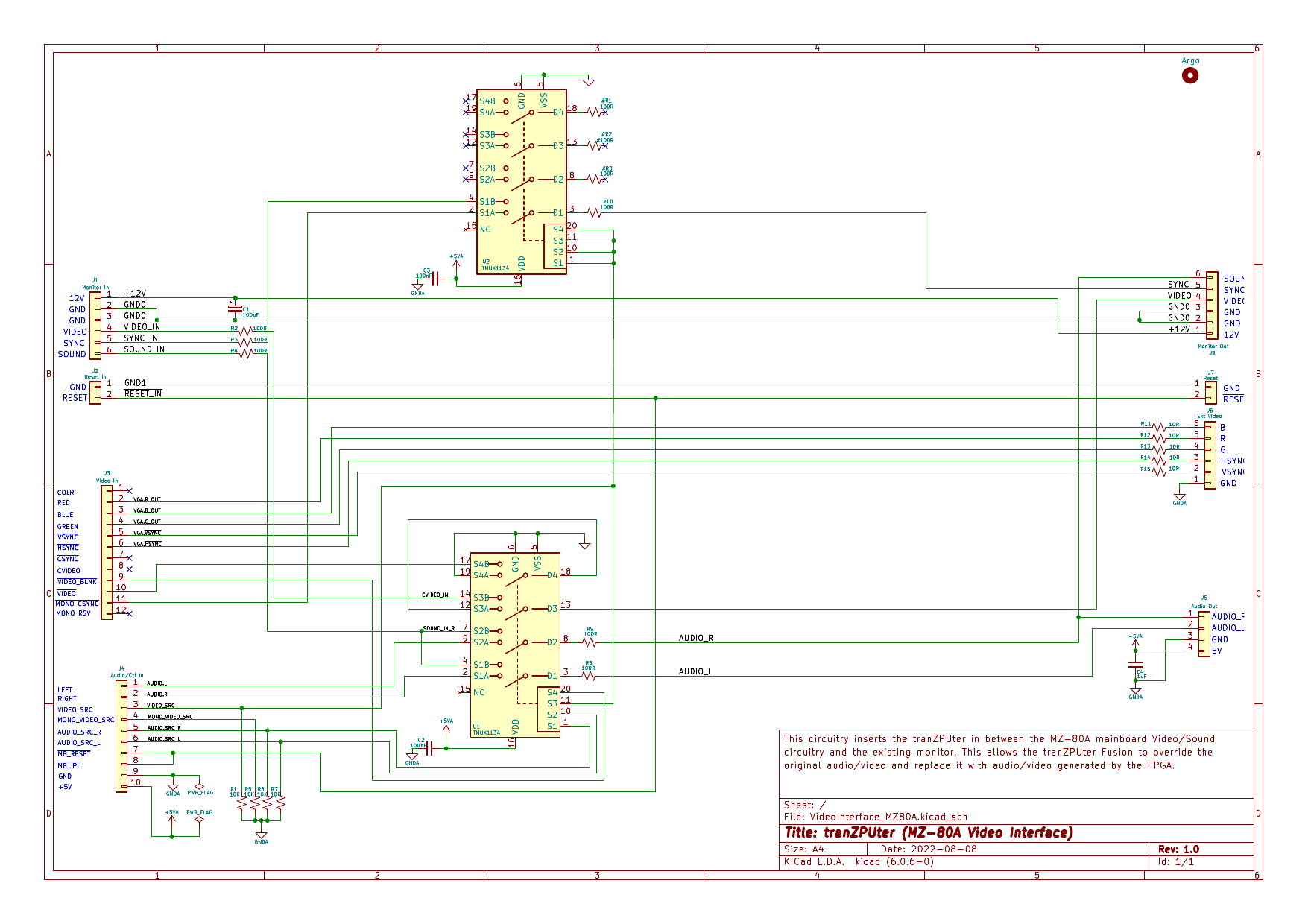
MZ-80A Video Interface PCB
The MZ-80A daughter board PCB is small and compact with a large punchout to enable connection with the mainboard CRT connector and thru connection of the data cassette signal connector. It plugs into the mainboard CRT monitor connector and then presents new CRT monitor, external Video and RESET In/Out switch connectors to be used with all the exising internal cabling.
--------------------------------------------------------------------------------------------------------
## Reference Sites
The table below contains all the sites referenced in the design and programming of the tranZPUterFusionX
--------------------------------------------------------------------------------------------------------
## Manuals and Datasheets
The table below contains all the datasheets and manuals referenced in the design and programming of the tranZPUterFusionX
| Datasheet |
Language |
Description |
| ADV7123 |
English |
Original 5V 30bit VideoDAC (discontinued) |
| GM7123 |
Chinese |
Chinese 3.3V version of the ADV7123 30bit VideoDAC converter. |
| CH340E |
Chinese |
USB to Serial UART converter. |
| EPM7512AEQFP144 |
English |
Altera 512 MacroCell 5V tolerant CPLD. |
| HXJ8002 |
English |
Class D power amplifier. |
| SOM2D01 |
English |
SigmaStar SOM Datasheet (original model). |
| REF3040 |
English |
Precise 4V reference voltage generator. |
| SY6280 |
English |
Power distribution switch, used for enabling and supplying USB Bus power. |
| TLC5602C |
English |
8bit VideoDAC converter. |
| TLV62569 |
English |
High efficiency Buck Converter. |
| TMUX1134 |
English |
Precision SPDT Analogue switch (Mux). |
| VCUT0714BHD1 |
English |
ESD Protection Diode. |
| USB Programmer |
English |
SigmaStar USB Programmer for SSD202 Processor. |
| SSD201 HW Checklist v10 |
English |
SigmaStar SSD201 Hardware Checklist. |
| SSD202D Reference v04 |
English |
SigmaStar SSD202 CPU Reference Manual. |
| SOM2D02_Pinout |
English |
SigmaStar SOM2D02 Pinout. |
| Z80 UserManual |
English |
Z80 User Manual. |
| SSD202D Product Brief |
English |
SigmaStar SSD202 CPU Product Brief. |
| SOM2D01 Datasheet |
English |
SigmaStar SOM2D01 Datasheet. |
--------------------------------------------------------------------------------------------------------
## Demonstration Videos
MZ-2000 Demo
MZ-700 Demo
--------------------------------------------------------------------------------------------------------
## Credits
The Z80 Emulation used in the
FusionX is (c) 1999-2022 Manuel Sainz de Baranda y Goñi, which is licensed under the LGPL v3 license, source can be found in
github.
The SSD202/SOM2D0X build system is based on Linux with extensions by SigmaStar and Industio, licensing can be found in their updated source files.
This design, hardware and software (attributable components excluding seperately licensed software) is licensed under the GNU Public Licence v3 and free to use, adapt and modify by individuals, groups and educational institutes.
No commercial use to be made of this design or any hardware/firmware component without express permission from the author.
The source and binary files in this project marked as GPL v3 are free software: you can redistribute it and-or modify it under the terms of the GNU General Public License as published by the Free Software Foundation, either version 3 of the License, or (at your option) any later version.
The source files are distributed in the hope that it will be useful, but WITHOUT ANY WARRANTY; without even the implied warranty of MERCHANTABILITY or FITNESS FOR A PARTICULAR PURPOSE. See the GNU General Public License for more details.
You should have received a copy of the GNU General Public License along with this program. If not, see http://www.gnu.org/licenses/.
--------------------------------------------------------------------------------------------------------
 ## Overview